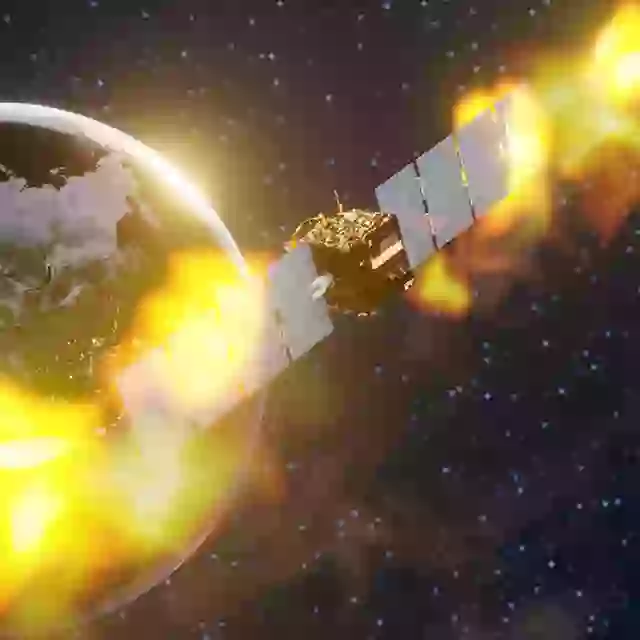
Likely to crash back on Earth in one piece, the lost satellite could be deadly
Rikki Loftus
A 1,100lbs Soviet satellite is expected to crash down back on Earth at 17,000mph this week.
The lost satellite was launched into space over 50 years ago and scientists are predicting that it could crash land anytime between May 9 and May 13.
And one astronomer believes to have an answer as to where on our planet it will land, with the entirety of the UK being in the firing line.
As part of the Kosmos 482 probe, the satellite was originally launched into space by the USSR in 1972 in order to collect information on Venus.
However, the probe suffered an engine malfunction while still in Earth’s orbit and it broke into four separate pieces.
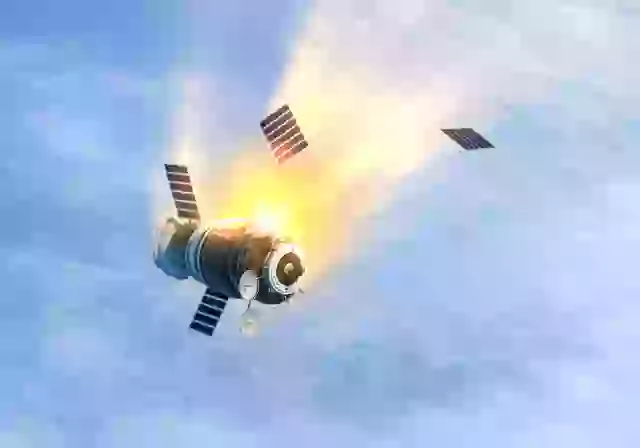
While the other pieces burned up over New Zealand, the final missing object, which was the probe’s landing module, is making its way back to Earth, according to experts.
Speaking to the Daily Mail, Dr Marco Langbroek who is a satellite tracker and astronomer at the Delft University of Technology, believes that the Soviet satellite will arrive back on Earth somewhere between latitude 52 degrees north and 52 degrees south.
If he is correct then this will mean that the satellite could hit the UK, with places south of Cambridge including Ipswich and Milton Keynes at risk of being struck.
And it’s certainly worrying if the space junk hits a populated region because, traveling at 17,000mph, it could be deadly if it were to collide with people.
Because this final piece of the satellite was designed to safely land on Venus, it is unlikely to burn up as it re-enters the Earth’s atmosphere and instead will likely land in one piece.
Langbroek added: “The risks involved are not particularly high, but not zero.”
It’s not clear yet where the object will land and predictions could change at the last minute due to solar weather that could move it off its course.
In a blog post, Dr Jonathan McDowell, who is an astronomer who tracks satellite re-entries, wrote: “The vehicle is dense but inert and has no nuclear materials.
“No need for major concern, but you wouldn’t want it bashing you on the head.”
He continued: “In which case I expect it’ll have the usual one-in-several-thousand chance of hitting someone.”
Also speaking to the Daily Mail, McDowell went on to say: “If this were to cause damage – or worse, to hurt someone – that would be something that the Russian government would be liable for.”
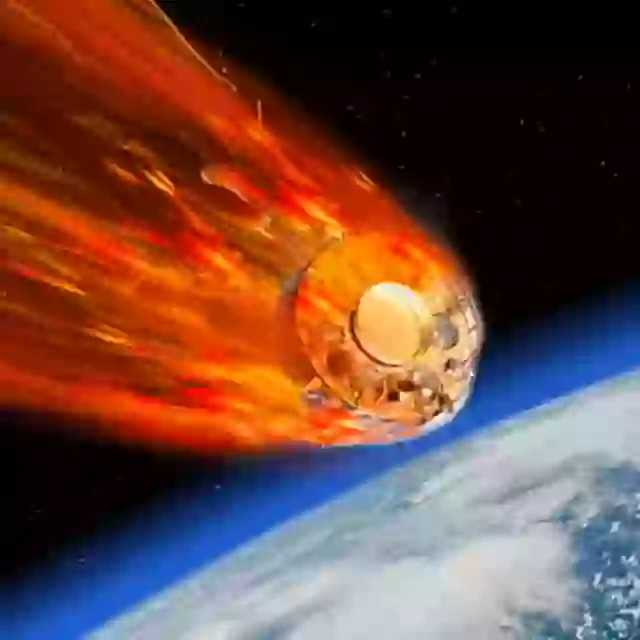
Failed Soviet satellite from 1972 is now hurtling back to Earth like a meteorite and could land anywhere
Rebekah Jordan
After over 50 years of circling our planet, a chunk of Soviet spacecraft is hurdling back to Earth – and nobody knows where it might land.
2025 has been a bit of a nail-biter when it comes to space objects heading our way.
Earlier this year, NASA scientists flagged a massive space rock with a 1-in-83 chance of striking Earth in 2032.
Meanwhile, astronaut Chris Hadfield warned of another asteroid coming ‘quite close to Earth’ in 2028, with a ‘one in 45 chance’ of making an impact.
Now, a half-tonne Soviet space probe that was designed to endure landing on Venus may be heading our way. Launched in 1972, the spacecraft reportedly never made it past the Earth’s orbit and its remains circled our planet for over five decades.
The spacecraft will tumble back to the Earth in as little as ‘two weeks from now’ and may ‘crash down hard’ like a meteorite, space lecturer and tracker Dr. Marco Langbroek wrote in a blog post and later shared on X.
“And from our current modelling, the reentry should happen near 10 May, give or take a few days,” the space object tracker said. “Over the past few months, the model consistently points to reentry within a few days of 9-10 May 2025.”
Dr. Langbroek, at the Delft University of Technology, added that there’s only a small chance the space probe will burn up on reentry.
“As this is a lander that was designed to survive passage through the Venus atmosphere, it is possible it will survive reentry through the Earth atmosphere intact, and impact intact,” he explained. And while the spacecraft is equipped with a parachute, there’s a good chance it no longer works.
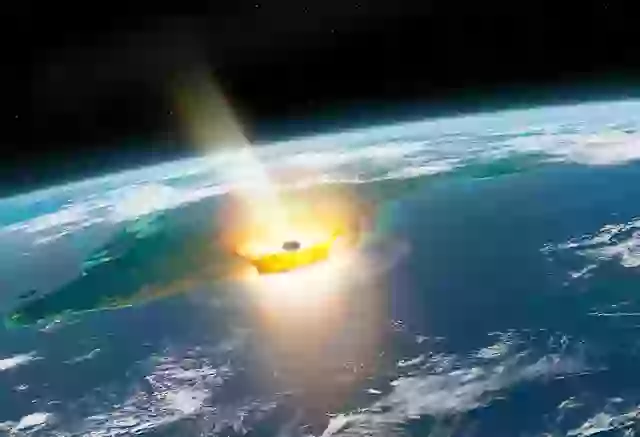
“If it survives reentry, it will come down hard,” Dr. Langbroek told Popular Science.
The probe is roughly a metre wide and weighs just under 500kg. It could reenter the atmosphere and hit the Earth at a speed of about 250kmph, the lecturer said, adding: “The risks involved are not particularly high, but not zero.”
More worryingly, pinpointing the exact time and location is unclear. “With an orbital inclination of 51.7 degrees, the reentry can occur anywhere between latitude 52 N and 52 S,” Dr. Langbroek described. This could be anywhere as far north as the UK and or as far south as New Zealand.
In the meantime, trackers continue to observe the space probe to gather more data about its landing whereabouts.
“The uncertainty in the reentry date will decrease once we get closer to the actual reentry, but even on the day, uncertainties will remain large,” Dr Langbroek continued.
For now, all we can do now is hope.
See More:

 Top 3 U.S. Army Sniper Rifles Of All Time
 THE NAVY SEALS’ TWO ORIGINAL AND LITTLE-KNOWN MISSIONS

 The Phoenix Lights: A Massive UFO Sighting in 1997
 Unwrapping the Secrets of a Perfect Cuban Sandwich: A Culinary Journey